India Just Made Its Biggest Bet on Coal Gasification. The Real Test Starts Before the Gasifier.
Imagine wearing a shirt made from coal. Or using fuel, fertiliser, plastics and industrial chemicals made from the same raw material that India has relied on for power generation for decades.
That is the promise behind coal gasification. It is not about burning coal for heat. It is about converting coal into syngas, then using that syngas to produce higher-value industrial molecules.
India has now placed a serious policy and financial bet on this pathway. The question is no longer whether coal gasification is on the national agenda. It is whether the projects being built can handle the coal they will actually receive.
What Is Coal Gasification?
Coal gasification is a thermochemical conversion process. Instead of complete combustion, coal is reacted with controlled oxygen, steam and heat to produce synthesis gas, or syngas, mainly a mixture of carbon monoxide and hydrogen.
Syngas can then be routed into downstream pathways such as methanol, ammonia, synthetic natural gas, hydrogen-rich streams, direct reduced iron, synthetic fuels and chemicals. These are not abstract outputs. They sit behind fertiliser, industrial fuels, chemical manufacturing and future low-carbon industrial routes.
For coal-bearing regions, the strategic implication is significant. A tonne of coal used only as fuel has one value pathway. A tonne prepared and converted into industrial feedstock can support a much wider manufacturing chain.
India’s Coal Gasification Push Has Scaled Sharply
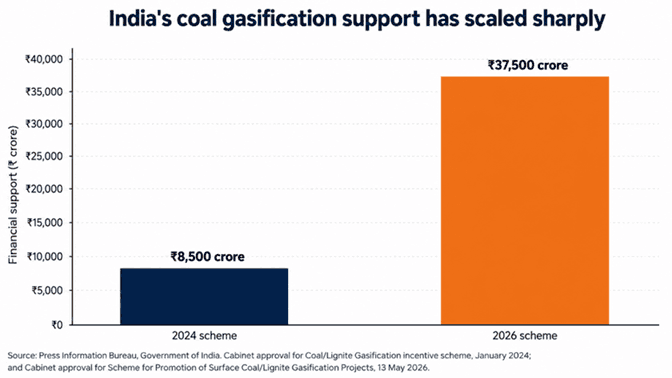
India’s coal gasification support has scaled from the ₹8,500 crore 2024 incentive scheme to the ₹37,500 crore 2026 surface coal and lignite gasification scheme. Source: Press Information Bureau, Government of India.
In May 2026, the Union Cabinet approved the Scheme for Promotion of Surface Coal/Lignite Gasification Projects with a total financial outlay of ₹37,500 crore. The scheme provides incentives up to 20% of the cost of plant and machinery, targets gasification of approximately 75 million tonnes of coal and lignite, and extends coal linkage tenure up to 30 years for syngas-linked projects, according to the Press Information Bureau.
This builds on the ₹8,500 crore coal and lignite gasification incentive scheme approved in January 2024. The broader national target remains 100 million tonnes of coal gasification by 2030, as set out under the National Coal Gasification Mission and reiterated by the Ministry of Coal.
Why This Investment Makes Strategic Sense
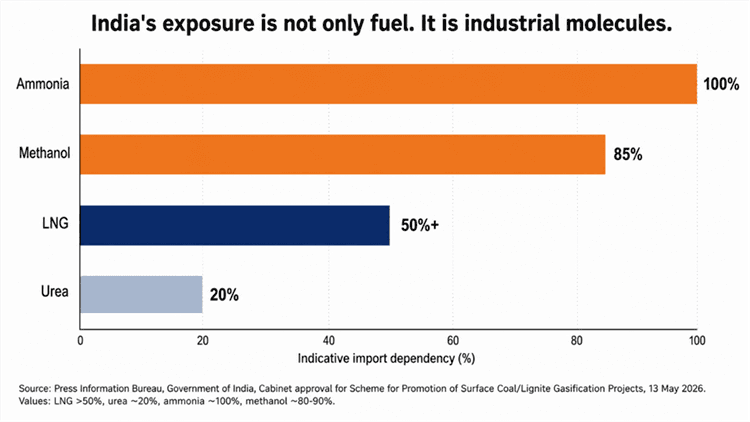
India’s exposure is not only in fuel. It also extends to industrial molecules such as ammonia, methanol and urea, where domestic syngas pathways could reduce part of the dependency. Source: Press Information Bureau, Government of India.
India has a large domestic coal resource base, but remains exposed to imports of several energy and industrial inputs. Government statements on the 2026 scheme cite import dependence of more than 50% for LNG, around 100% for ammonia, 80-90% for methanol and around 20% for urea.
This matters because energy and industrial-molecule imports are not isolated line items. When global prices rise, the impact travels into fertiliser, agriculture, manufacturing and inflation. Coal gasification is therefore being positioned not only as an energy programme, but also as an industrial resilience strategy.
The logic is straightforward: if India can convert part of its domestic coal and lignite base into syngas and downstream products, it may reduce exposure to imported molecules in selected sectors. The execution, however, is more complex than the policy headline.
The Challenge Most Coverage Is Missing: Feedstock Quality
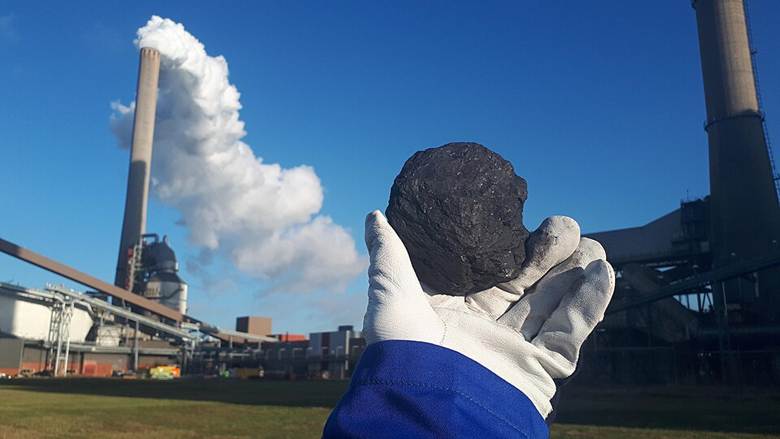
Coal quality directly shapes gasification efficiency, reliability and economics. Photograph by Adrem68, via Wikimedia Commons, CC BY-SA 4.0.
Gasifiers are not forgiving systems. They are capital-intensive, process-sensitive assets designed around specific feed envelopes. The coal entering the system affects oxygen demand, heat balance, ash and slag load, syngas quality, gas cleaning and downstream reliability.
India’s coal is often high in ash and variable in quality. Many domestic thermal coal streams operate in the 35-45% ash range, and the mineral matter in Gondwana coal can be more intimately associated with the coal matrix than in many internationally traded coals. This makes feed preparation and technology selection critical.
The issue is not only ash percentage. It is variability. A gasifier may be designed for one expected range of ash, moisture, calorific value and mineral composition. If the actual feed shifts meaningfully, plant performance and economics can shift with it.
Coal quality must therefore be treated as a design parameter, not an afterthought.
Why Dry Beneficiation Belongs in the Gasification Conversation
Even where high-ash gasification is technically possible, reducing and stabilising ash upstream can improve the operating envelope, lower the inert load entering the gasifier and make feed behaviour more predictable.
Conventional wet washing can reduce ash, but it requires water and slurry handling. In several coal-bearing regions, water allocation, permitting and operating complexity are not minor considerations. For certain seams, the liberation characteristics of Indian coal also limit what any beneficiation route can economically achieve.
X-ray transmission based dry beneficiation works differently. It uses X-ray attenuation differences to distinguish coal-rich and mineral-rich particles on a conveyor, enabling sensor-based sorting without process water. For suitable size fractions and liberation characteristics, dry sorting can reduce ash, improve calorific value and increase feed consistency.
The larger contribution to coal gasification is feed conditioning: making the input more consistent before it enters a high-value conversion pathway. In a system where feed stability influences syngas quality, auxiliary power, ash handling and downstream performance, consistency has direct economic value.
The Larger Picture
Coal gasification does not begin inside the gasifier. It begins when raw coal is selected, prepared, sorted and made suitable for conversion.
India’s programme is now serious, funded and in motion. The policy platform is in place. But the execution risk is real. The difference between a transformative industrial programme and underperforming assets may come down to whether gasification plants are designed around the real quality and variability of Indian coal.
This is the part of the value chain Novasensa is focused on through NovaX: improving coal quality before it enters high-value industrial conversion pathways.


