Lithium made high-energy rechargeable batteries practical. Its next strategic role is to help build a circular supply of battery materials.
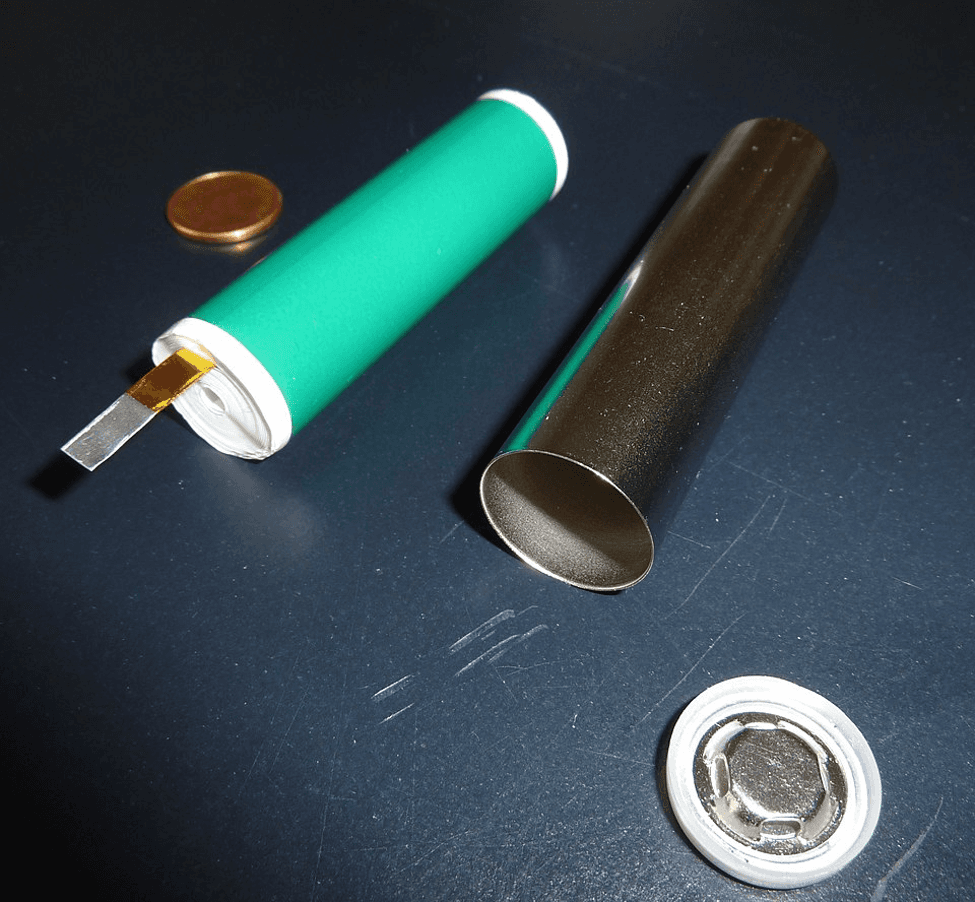
A cylindrical 18650 lithium-ion cell before final assembly, showing the wound electrode roll, metal casing and end cap. Image by RudolfSimon via Wikimedia Commons, CC BY-SA 3.0.
Why is lithium used in batteries? Lithium combines low atomic mass, high electrochemical potential and mobile ions. Together, these properties allow rechargeable batteries to deliver high cell voltage and high specific energy, which means more stored energy for a given mass. That combination helped make portable electronics, electric vehicles and grid-scale battery storage practical.
The same success has created a supply-chain challenge. Lithium demand is increasingly tied to energy applications, while mining, refining, active-material production and cell manufacturing remain concentrated in a limited number of countries and companies. For India, recycling spent batteries can create a domestic secondary source of lithium and other useful materials. It will not eliminate the need for primary supply, but it can reduce losses and strengthen resilience.
Why lithium is used in batteries
Lithium is the lightest metal and the third element in the periodic table. Its low density is often demonstrated by noting that it can float on water, although metallic lithium reacts with water and must be handled under controlled conditions. The property that matters inside a battery is not visual lightness alone. It is lithium's electrochemical behaviour.
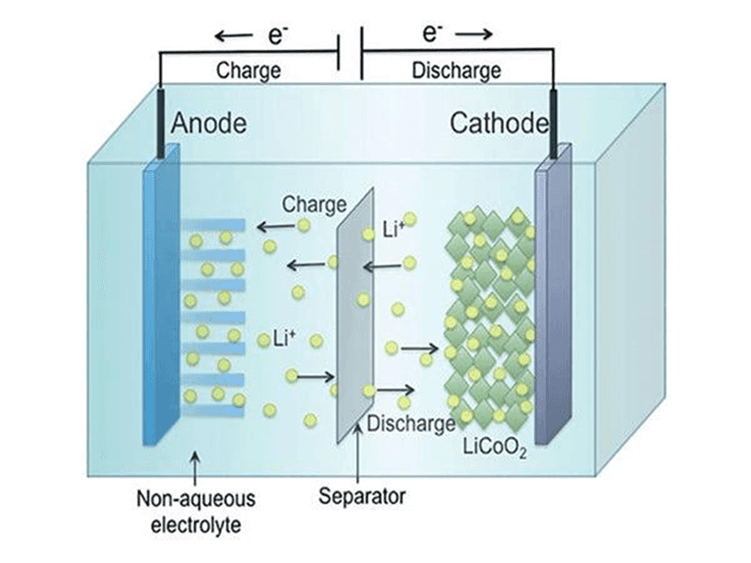
In a lithium cobalt oxide cell, lithium ions move through the electrolyte and separator between the anode and cathode, while electrons travel through the external circuit during charging and discharging. Diagram by Tycorun.
A lithium-ion cell stores and releases energy by moving lithium ions between two host electrode materials. During charging, ions leave the positive electrode and enter the negative electrode. During discharge, they travel back through the electrolyte while electrons move through the external circuit and power the device. This intercalation mechanism can be repeated for many cycles, although every real battery gradually loses capacity through chemical and structural degradation.
Lithium therefore offers three linked advantages:
Low mass, which supports high energy per unit of battery weight.
High electrochemical potential, which helps produce a high cell voltage.
Small, mobile ions that can move reversibly through suitable electrode structures.
Lithium does not work alone. Battery performance depends on the complete cell design, including the cathode, anode, electrolyte, separator, current collectors, manufacturing quality and battery-management system. Lithium-ion is also a family of chemistries. Lithium iron phosphate, nickel manganese cobalt and nickel cobalt aluminium cells make different trade-offs in cost, energy density, safety, cycle life and material value.
How lithium-ion batteries made energy portable
The commercial breakthrough emerged from decades of research by M. Stanley Whittingham, John B. Goodenough and Akira Yoshino. The Nobel Prize's account of the 2019 Chemistry Prize explains how their work established practical electrode concepts and led to commercially viable lithium-ion batteries. Sony introduced commercial cells in 1991, initially for consumer electronics.
The technology then moved through three major markets. It first reduced the weight and increased the runtime of portable electronics. It later enabled electric vehicles with useful driving range. More recently, it has become a major source of flexibility for power systems that must balance variable solar and wind generation.
The scale of that transition is now visible. According to the International Energy Agency's 2026 battery-market analysis, global lithium-ion battery deployment in 2025 was six times the 2020 level. Electric vehicles accounted for more than 70% of deployment, while battery energy storage represented more than 15%. Portable electronics, once the main market, accounted for less than 5%.
From portable energy to strategic dependency
A battery supply chain does not begin or end at a cell factory. It includes mineral extraction, refining, precursor and active-material production, cell manufacturing, pack assembly, use, collection and recovery. A country can expand electric mobility and battery storage while remaining exposed if critical upstream and midstream stages are located elsewhere.
India has started addressing this gap through industrial and minerals policy. The Ministry of Heavy Industries' Production Linked Incentive scheme for Advanced Chemistry Cell battery storage was created with an outlay of Rs 18,100 crore and a target of 50 GWh of domestic manufacturing capacity. In parallel, the Government of India's National Critical Mineral Mission, approved in 2025, covers the value chain from exploration and processing to recovery from end-of-life products.
These programmes can strengthen manufacturing capacity, but cell manufacturing alone does not secure lithium chemicals, cathode materials or other upstream inputs. Resilience requires multiple routes: diversified imports, responsible primary production where viable, material efficiency, longer battery life and recovery of secondary materials.
Why spent batteries are an above-ground resource

A researcher displays material produced by crushing a lithium-ion battery, including dark electrode powder and separated copper and aluminium foil fragments. Photo by Jens Schlueter/AFP via Getty Images.
A battery reaches end of life when it no longer meets its required performance or safety specification. That does not mean its constituent elements have vanished. Depending on the chemistry and design, spent batteries can contain lithium, graphite, copper, aluminium, iron, phosphorus, nickel, cobalt and manganese. An LFP battery, for example, does not contain the nickel and cobalt typical of many NMC batteries. Recycling systems must therefore be chemistry-aware rather than treating all black mass as equivalent.
The economic and strategic value of recycling comes from converting this complex feed into controlled products that can re-enter industrial supply chains. It also reduces the need to dispose of reactive cells and helps retain materials that have already passed through mining, refining and manufacturing.
Recycling is not a complete substitute for mining while the total battery fleet is expanding. Available end-of-life feedstock is smaller than the material required for new market growth. In its 2024 assessment of critical-mineral recycling, the International Energy Agency estimates that battery recycling could meet about 20% to 30% of lithium, nickel and cobalt demand by 2050 under its assumptions, with collection rates being the most important variable.
How hydrometallurgical recycling recovers battery materials
Hydrometallurgy uses aqueous chemistry to dissolve and separate selected materials. A practical recycling route usually combines mechanical and chemical operations rather than relying on one step. A simplified sequence is:
Safe collection, discharge, dismantling and sorting of batteries or production scrap.
Mechanical size reduction and physical separation to produce metal fractions and black mass.
Leaching under controlled chemical conditions to transfer target elements into solution.
Impurity removal and selective separation using operations such as precipitation, solvent extraction or ion exchange.
Product finishing to generate defined salts, precursors or other marketable intermediates.
Process claims must be interpreted carefully. Leaching extraction, overall plant recovery and final product purity are different metrics. Performance depends on feed chemistry, state of charge, pretreatment, reagent system, temperature, residence time, solid-to-liquid ratio, impurity control and the product specification. A credible recycling process therefore needs complete mass balances and product analysis, not a single headline recovery percentage.
India's Battery Waste Management Rules, 2022, published by the Central Pollution Control Board, created an extended producer responsibility framework for waste batteries. Collection and traceability are essential because no recovery process can operate reliably without predictable, legally managed feedstock.
What India needs to build a circular battery supply chain
India can turn growing battery use into a secondary-material opportunity, but only if collection, processing and markets develop together. Five conditions are especially important:
Predictable collection and traceability under EPR, including safe storage and transport.
Representative sampling and chemistry-based valuation of black mass and other feedstocks.
Recovery processes designed around product specifications and complete material balances.
Domestic offtake for recovered salts, precursors and metal products.
Transparent reporting of recovery, purity, waste generation, water use and reagent consumption.
This is the strategic transition behind lithium's next chapter. The first lithium-ion revolution made electricity portable. The next must make battery materials recoverable at industrial scale.
The battery is not the end of the lithium story
Lithium became indispensable because its properties enabled rechargeable batteries with high voltage and useful energy density. That success now links consumer electronics, electric mobility and power systems to a complex mineral and manufacturing chain. For India, end-of-life batteries are not waste without value. They are a domestic feedstock that can support a more resilient critical-mineral economy when collection, chemistry and product quality are controlled.


